
IRIS login | Reed College home Volume 90, No. 4: December 2011
Reediana
Edited by Robert Levin ’79
Work Meets Life: Exploring the Integrative Study of Work in Living Systems (MIT Press, 2011)
By William Abernathy ’88
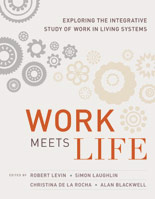
What is work? Ask a physicist, and she might breezily answer, “Force times distance.” Ask a biologist, and you might hear about cells converting ATP to ADP + P. Ask an economist, and you might hear about the interplay of labor power, resources, and capital. Ask Dad, and he might tell you, “What I did to put you through that college in Oregon.” Who’s right? All of them.
In Work Meets Life, Bob Levin (himself a biologist) gathers a cross-disciplinary panel of experts to discuss work, and the interplay of work and living systems, from their respective areas of expertise. His goal is to forge a better understanding and a more focused approach: a study of work that breaches the disciplinary boundaries that separate these perspectives.
The book begins with the biochemical building blocks of work, where microscopic life forms wrest order from the brute verities of thermodynamics, and tackles increasingly complex systems, moving from microbial metabolism to management theory, with stops along the way to discuss the energy-information tradeoffs of the Pony Express and the active energetic balancing act of satisfied workers. The essayists here assembled—biologists, neurologists, and industrial designers—refer frequently to each other’s efforts, indicating the collegial, cross-disciplinary approach that went into the book.
Though the central thesis of Work Meets Life is tantalizing, the book doesn’t always convince. Worker dissatisfaction, for example, is reduced through seductive Cartesian curves to be mere imbalances in the worker’s stored versus expended energy, with no room in the clean graphs for “my boss is a jerk.” But we should expect some rough edges whenever an interdisciplinary team tries a radically different approach to a single subject. To its credit, Work Meets Life suggests many more questions than it answers. Having brought us from microbes to human workplace relations, it would be interesting to see this grand unification extended to the macrowork of organizations, and, indeed, that of economies and nations. More work for later.
Editor's Note
Features
- The New (Olde) Reed Almanac
- Such Sweet Thunder
- Guerrilla Archivist
- Avoiding Your Parents’ Basement
- The Small Chill
- Darkness, Light, and Drama in the Oresteia
- Steve Jobs: Prodigal Son
- Helen Stafford: Green Pioneer
- Stage Struck
- Smog Buster Leaves $2.5 Million to Reed
- Peter Russell: The Gene Genie
- Ed Segel: History’s Ambassador
Reediana
- Roger Porter: Bureau of Missing Persons
- Robert Levin ’79: Work Meets Life
- Kate Christensen ’86: The Astral
- Kraig Kraft ’00: Chasing Chiles
- Reediana Briefs
Eliot Circular
- 100 Years of Greatness
- Joining the Tribe
- The Art Spark
- Searching for a Leader
- Navy Secretary Wins Eliot Award
- New Faces: Trustees
- New Faces: Professors
Empire of the Griffin
Alumni Profiles
In honor of Reed’s 100th birthday, make your gift this year and pledge your continued support in the future.

REED MAGAZINE STAFF
EDITOR
503/777-7596
CLASS NOTES EDITOR
503/777-7591
WEB DESIGNER
503/459-4632
LATEST COMMENTS
steve-jobs-1976 I knew Steve Jobs when he was on the second floor of Quincy. (Fall...
Utnapishtim - 2 weeks ago
Prof. Mason Drukman [political science 1964–70] This is gold, pure gold. God bless, Prof. Drukman.
puredog - 1 month ago
virginia-davis-1965 Such a good friend & compatriot in the day of Satyricon...
czarchasm - 4 months ago
John Peara Baba 1990 John died of a broken heart from losing his mom and then his...
kodachrome - 7 months ago
Carol Sawyer 1962 Who wrote this obit? I'm writing something about Carol Sawyer...
MsLaurie Pepper - 8 months ago
William W. Wissman MAT 1969 ...and THREE sisters. Sabra, the oldest, Mary, the middle, and...
riclf - 10 months ago