
IRIS login | Reed College home Volume 92, No. 3: September 2013
Reediana
Fear: Across the Disciplines (University of Pittsburgh Press, 2012)
Edited by Prof. Benjamin Lazier [history 2005–] and Jan Plamper
By Angie Jabine ’79
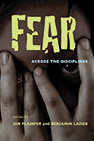
The more we learn about the brain, the clearer it becomes that fear is the most ancient and powerful of human experiences. But what is fear exactly—is it an emotion, a physiological state, or a cognitive recognition of an imminent threat? How is fear adaptive, and why does normal fearfulness so often shift into phobic overdrive?
Approaching these questions from the varying perspectives of clinical psychology, neuroscience, philosophy, political theory, economics, and cultural history, Fear: Across the Disciples gives us many tools for thinking about fear and its impact on every aspect of life.
By far the most substantial piece is Ruth Leys’ critique of psychologist Paul Ekman’s research on facial and bodily cues. Over several decades, Ekman’s work has become a linchpin of government and corporate efforts to identify potential terrorists or other troublemakers, but Leys joins many others who have called Ekman’s assumptions and research methods into question.
“Fear of a Safe Place,” the essay contributed by Reed’s own Prof. Jan Mieszkowski [German 1997–], reminds us that our fascination with horrific events is nothing new, and that the phenomenon of public rubbernecking attracted the interest of Enlightenment figures such as Chateaubriand, Immanuel Kant, and Edmund Burke, the latter of whom described terror as “a passion which always produces delight when it does not press too close.”
Historian Harold James discusses the role of shareholder panics in the stock market crashes that produced the Great Depression and the current Great Recession, and political scientist Corey Robin analyzes the uses of fear in shaping public discourse and policy. As the run-up to the 2003 invasion of Iraq suggests, the greater the perceived threat—such as “weapons of mass destruction” in the hands of our adversaries—the less proof we demand that the threat is actually real, and the more likely we are to accept restraints on our constitutional rights.
For me this anthology’s least familiar and thus most fascinating material appears in historian Jan Plamper’s discussion of Russian military psychology in the early 20th century, when the pre- and postcombat stresses experienced by soldiers stopped being a shameful taboo and became the object of research and therapy rather than punishment.

Web Special
Editor's Note
Letters
- Let Sleeping Cats Lie . . .
- Remembering Professor Arch
- Remembering Jacqueline Kohler Koch ’70
- Remembering John Goldsmith ’88
- They Said I Was a Communist
- The Lincoln Brigade
- Smackdown: Bridge vs. Scribe
Eliot Circular
- Grads Asked to Fix Dents
- Pink Shoes, Blue Glow
- Shock! Horror! Quest Turns 100!
- Considering Reed’s Future
- Environmental Studies Gain Momentum
- Tangled up in Tango
- How a Galaxy Evolves
- Chem Major Nabs Class of ’21 Award
- Student and Faculty Awards
Empire of the Griffin
- From the Alumni Board President
- Alumni Overrun Campus at Reunions: Reedfayre ’13
- Welcome New Grads
- Meet Your Alumni Board
Features
- The Canvas and the Clue
- What is a Reedie, Anyway?
- Coloring Outside the Lines
- The Mythbuster
- Page Turner
- What do you do with a degree from Reed?
- Last Lectures
- In Memoriam: Steve Arch
- Composer of Note (and Notes)
Reediana
- Blue Plate Special: Kate Christensen ’86
- Fear: Prof. Benjamin Lazier
- Revolutions in Twentieth-Century Physics: Prof. David Griffiths
- Reediana Briefs
Apocrypha

REED MAGAZINE STAFF
EDITOR
503/777-7596
CLASS NOTES EDITOR
503/777-7591
WEB DESIGNER
503/459-4632
LATEST COMMENTS
steve-jobs-1976 I knew Steve Jobs when he was on the second floor of Quincy. (Fall...
Utnapishtim - 2 weeks ago
Prof. Mason Drukman [political science 1964–70] This is gold, pure gold. God bless, Prof. Drukman.
puredog - 1 month ago
virginia-davis-1965 Such a good friend & compatriot in the day of Satyricon...
czarchasm - 4 months ago
John Peara Baba 1990 John died of a broken heart from losing his mom and then his...
kodachrome - 7 months ago
Carol Sawyer 1962 Who wrote this obit? I'm writing something about Carol Sawyer...
MsLaurie Pepper - 8 months ago
William W. Wissman MAT 1969 ...and THREE sisters. Sabra, the oldest, Mary, the middle, and...
riclf - 10 months ago